
 Pareekh Jain
The Next Growth Opportunity for Telecom Operators and Engineering Service Providers
Telcos enabled connectivity but missed the value creation opportunity in the earlier two waves.
In the internet era, value was captured by web business such as Amazon, Google, Facebook, etc.
In the mobile era, value was captured by mobile OEMs such as Apple, Samsung, and mobile-based businesses such as Uber, Zomato, etc.
Now there is another opportunity with Physical AI for Telcos.
Physical AI is emerging as an important opportunity for telecom operators and engineering service providers . As AI moves towards controlling robots, autonomous vehicles, and industrial equipment, connectivity will become an increasingly important part of the AI ecosystem.
For telecom operators, Physical AI could create new revenue opportunities beyond traditional connectivity services. For ESPs, it offers an opportunity to leverage existing telecom engineering capabilities and expand into Industry 4.0, robotics, edge AI and industrial automation.
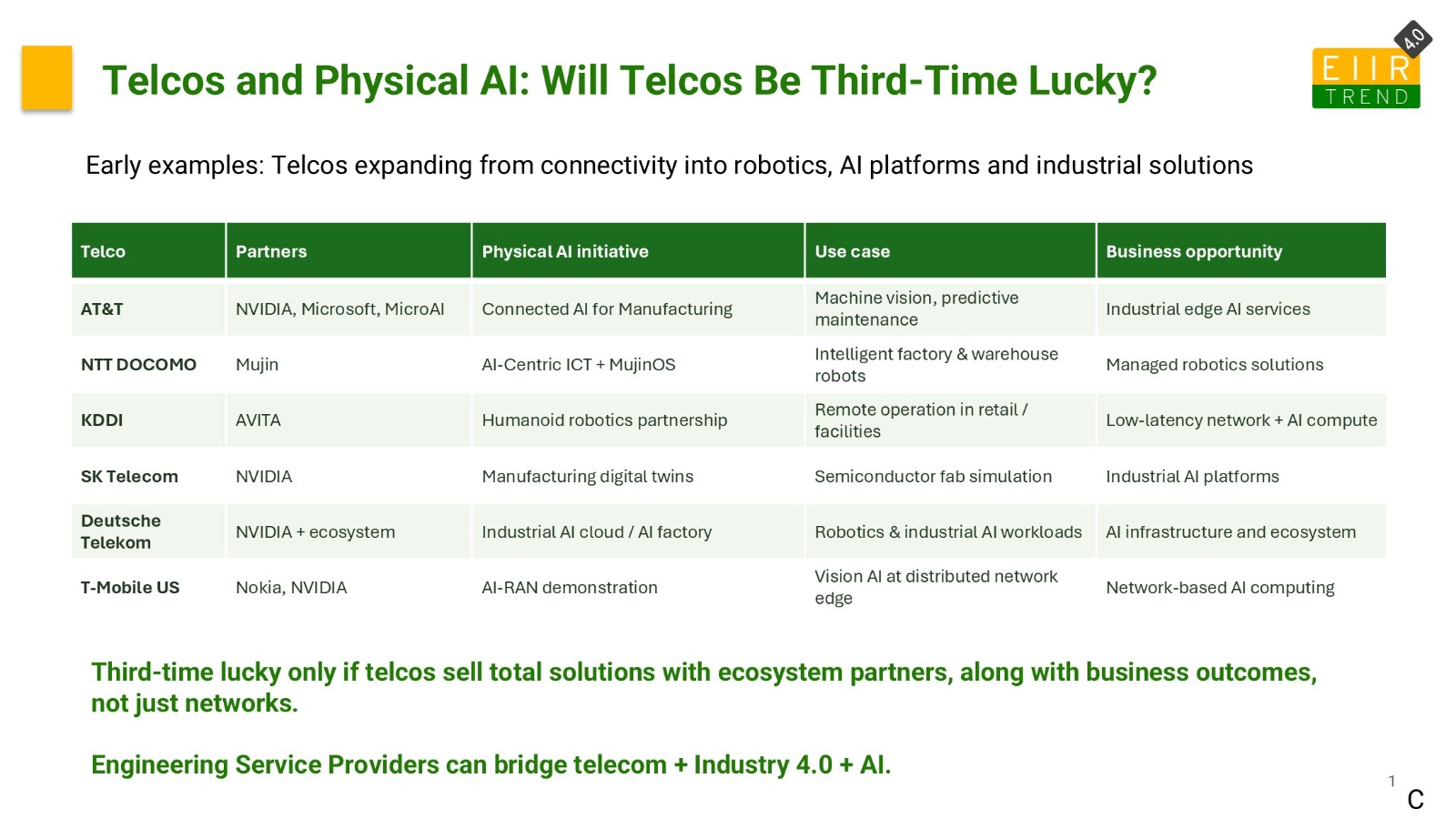
The early developments are encouraging. Telecom operators including AT&T, NTT, SK Telecom, Deutsche Telekom, KDDI and China Telecom are exploring Physical AI through partnerships with NVIDIA, robotics companies, network equipment providers and industrial enterprises.
However, the real opportunity is not simply connecting robots. It is enabling, integrating and managing intelligent physical operations.
1. Physical AI Could Become a New Growth Engine for Telcos
Traditional telecom connectivity is increasingly commoditized, putting pressure on operators to find new revenue streams.
Physical AI offers an opportunity to move beyond selling network capacity towards providing integrated solutions combining private 5G, edge computing, AI, security, cloud and robotics platforms.
Several telecom operators are already exploring different business models.
AT&T has developed Connected AI for Manufacturing with NVIDIA, Microsoft and MicroAI. The platform combines 5G, IoT, edge AI, machine vision and predictive maintenance. Early pilots cited in the presentation reported a 70% reduction in waste and a 35% improvement in fulfillment efficiency.
NTT DOCOMO has partnered with robotics company Mujin to combine telecom infrastructure, Network as a Service, cloud, security and managed services with the MujinOS robotics automation platform.
KDDI is partnering with AVITA to support humanoid robots through low-latency connectivity, AI data centers and deployment infrastructure.
These examples suggest that telecom operators are moving from connectivity providers towards Physical AI solution providers.
Key takeaway for telcos: Connectivity alone may not deliver significant differentiation. The larger opportunity lies in bundling connectivity with AI platforms, robotics software, edge computing and managed services.
2. Robotics Could Finally Accelerate Enterprise Private 5G Adoption
Private 5G has been promoted for several years as an important enabler of Industry 4.0. However, enterprise adoption has been slower than expected because many organizations struggled to establish compelling business cases.
Physical AI could change this equation.
Robots, autonomous mobile systems and intelligent industrial equipment increasingly require reliable connectivity for coordination, monitoring, data exchange and remote operations.
A particularly interesting development is that demand for private 5G could shift from a telecom-led push to an application-led pull.
For example, China Telecom, ZTE, DroidUp and AgiBot are collaborating on private 5G connectivity for robotics. AgiBot has also secured an order involving nearly 100 robots for automotive components manufacturer Fulin Precision.
BMW's Physical AI initiatives provide another example. Its Leipzig humanoid robotics pilot builds on existing private 5G infrastructure developed with Vodafone and Nokia. Its Spartanburg plant also operates an industrial private 5G network supported by Verizon.
These developments illustrate how robotics could strengthen the business case for industrial connectivity.
Key takeaway for telcos: Robotics companies could become important partners and influencers in enterprise private 5G adoption. Telcos should develop joint go-to-market strategies with robotics and automation providers rather than relying exclusively on network-led sales.
3. AI-RAN Could Transform Telecom Networks into Distributed AI Infrastructure
One of the most interesting developments is the convergence of AI and radio access networks, commonly described as AI-RAN.
Traditionally, telecom networks have primarily transported data. AI-RAN creates the possibility of using network infrastructure to support AI computing closer to devices and physical operations.
NVIDIA, T-Mobile US and Nokia are demonstrating AI-RAN infrastructure that can support distributed edge AI and vision AI applications.
SoftBank and Fujitsu have also piloted AI-RAN using NVIDIA's AI Aerial platform, exploring how network computing capacity can support AI workloads while maintaining telecom performance.
NVIDIA is working around AI-RAN opportunities for autonomous vehicles, industrial robotics, machine vision and critical infrastructure.
This could create two opportunities for telecom operators: improving network economics through shared computing infrastructure and developing new services for AI applications.
However, commercial success will depend on the availability of usable computing capacity, application demand, latency requirements and the economics of operating distributed AI infrastructure.
Key takeaway for telcos: AI-RAN could create an additional monetization opportunity for telecom infrastructure. Operators should evaluate where distributed AI computing delivers advantages over conventional cloud and enterprise edge architectures.
4. Physical AI Creates Seven Opportunities for Engineering Service Providers
Physical AI could provide ESPs with an opportunity to diversify beyond traditional telecom and network equipment engineering.
There are seven potential service areas:
- Physical AI product engineering for network equipment providers: Developing AI-enabled network functions, sensing capabilities and edge computing solutions.
- Physical AI platform engineering for telcos: Integrating IoT, 5G, cloud, edge computing, data platforms and AI capabilities.
- New Physical AI solution development: Helping telecom operators build industry-specific offerings with technology partners such as NVIDIA.
- Physical AI systems integration: Connecting robots, industrial equipment, enterprise applications, networks and AI platforms.
- Enterprise 5G and future 6G connectivity engineering: Designing, deploying and managing industrial connectivity infrastructure for autonomous operations.
- Engineering partnerships with robotics and humanoid companies: Supporting robotics software, communication interfaces, device integration, testing and deployment.
- Enterprise Physical AI use-case development: Working with telecom operators to deliver robotics, intelligent inspection, predictive maintenance and autonomous operations solutions.
The opportunity is particularly relevant for ESPs with established telecom engineering relationships and Industry 4.0 engineering practices.
Key takeaway for ESPs: The most attractive opportunity is likely to come from combining telecom engineering, Industry 4.0 and AI capabilities rather than offering connectivity engineering as a standalone service.
5. Telecom Engineering Skills Are Transferable, but Industry 4.0 Expertise Is Essential
ESPs already possess valuable capabilities in radio access networks, network software, telecom protocols, private LTE/5G, network security and edge infrastructure.
Many of these skills are transferable to Physical AI deployments.
However, industrial environments require additional capabilities that traditional telecom engineering teams may not possess.
These include robotics, PLCs, SCADA, industrial control systems, functional safety, digital twins, OT cybersecurity, machine vision and manufacturing operations.
This creates an opportunity for ESPs to build multidisciplinary engineering teams.
A telecom engineering provider that understands network latency but lacks knowledge of factory operations may struggle to deliver an end-to-end Physical AI solution.
Conversely, an Industry 4.0 engineering provider with strong robotics expertise but limited wireless networking capabilities may need telecom engineering partners.
Key takeaway for ESPs: The winning capability combination will be Telecom Engineering + Industry 4.0 + AI Engineering. Cross-skilling, partnerships and selective acquisitions could help ESPs develop these capabilities.
6. The Enterprise Buying Center Is Changing
Traditional telecom engineering services are largely sold to telecom operators and network equipment providers.
Physical AI changes the customer landscape.
The enterprise buying center increasingly includes plant operations, manufacturing engineering, OT teams, supply chain leaders and automation executives.
These customers are less interested in network technology for its own sake. Their priorities include reducing downtime, improving productivity, enhancing worker safety, increasing throughput and automating repetitive activities.
This requires a different sales approach.
Rather than selling private 5G infrastructure, providers must demonstrate how connectivity enables a measurable industrial outcome.
The partnership ecosystem is also becoming more important.
Key takeaway for ESPs: Physical AI requires a shift from telecom-centric selling to outcome-led industrial selling. Partnerships with robotics companies, network equipment providers, telcos and AI platform companies will become essential.
7. Competition Will Intensify Across the Physical AI Ecosystem
Physical AI connectivity is attracting several categories of competitors.
Telecom operators want to own connectivity and managed services. Network equipment providers such as Ericsson and Nokia are extending their infrastructure capabilities. NVIDIA is helping shape AI computing architectures. Industrial automation providers bring deep operational technology expertise.
Meanwhile, global systems integrators, engineering service providers and infrastructure services companies are positioning themselves as implementation partners.
Local industrial integrators also have advantages through established relationships with manufacturing plants and knowledge of local operating environments.
For ESPs, telecom expertise alone will not guarantee success.
Differentiation will increasingly depend on the ability to integrate multiple technologies, deliver industry-specific solutions and demonstrate measurable business outcomes.
Key takeaway for ESPs: A credible Physical AI offering must go beyond repackaging private 5G services. It needs industrial domain knowledge, robotics integration, AI engineering, operational reliability and measurable customer ROI.
8. Physical AI Must Avoid the Mistakes of Private 5G, MEC and Industry 4.0
Despite the opportunities, Physical AI faces familiar commercialization challenges.
Private 5G, multi-access edge computing and Industry 4.0 generated significant industry enthusiasm, but adoption often progressed more slowly than expected.
Enterprises faced high implementation costs, fragmented technology ecosystems, integration complexity and uncertain returns.
Physical AI could face similar obstacles.
Robotics investments require more than connectivity. Enterprises must consider hardware costs, safety, maintenance, workforce readiness, software integration and operational changes.
However, there is an important difference this time.
A growing ecosystem of robotics companies, AI infrastructure providers and investors is actively developing Physical AI solutions. NVIDIA's involvement is also helping bring AI computing, simulation and robotics ecosystems closer together.
This could accelerate experimentation and commercialization, although large-scale adoption remains uncertain.
Key takeaway for telcos and ESPs: Physical AI should be approached through focused, ROI-driven deployments. Successful providers will prioritize practical industrial applications over technology-led demonstrations.
Final Takeaways: What Telcos and ESPs Should Do Next
For telecom operators
- Move beyond connectivity to integrated Physical AI platforms and managed services.
- Build partnerships with robotics companies, NVIDIA, network equipment providers and industrial integrators.
- Position private 5G around measurable robotics and automation use cases.
- Explore AI-RAN as a potential platform for distributed AI computing and new revenue streams.
- Develop industry-specific solutions for manufacturing, logistics, defense and critical infrastructure.
For engineering service providers
- Leverage existing telecom engineering capabilities to enter Physical AI opportunities.
- Combine telecom, Industry 4.0 and AI engineering expertise.
- Build partnerships across the telecom, robotics and AI ecosystems.
- Target plant operations, manufacturing and supply chain buying centers alongside traditional telecom customers.
- Develop reusable Physical AI engineering solutions and focus on deployments with demonstrable ROI.
Conclusion: From Connecting People to Connecting Robots and Operations
The telecom industry has evolved from connecting people to connecting devices. Physical AI could represent the next phase: connecting intelligent machines that sense, reason and act in the physical world.
For telecom operators, the opportunity is to move from selling connectivity to enabling intelligent operations.
For engineering service providers, it is an opportunity to transform traditional telecom engineering capabilities into higher-value industrial and AI engineering services.
The biggest winners may not necessarily be the companies that own the networks or build the robots. They could be the companies that successfully bring together connectivity, computing, intelligence and industrial operations.
Physical AI is still at an early stage, and commercial success is far from guaranteed. But it creates a new opportunity for telecom operators and engineering service providers to participate in the next wave of industrial transformation.



 Pareekh Jain
Founder of Pareekh Consulting & EIIRTrends
Add comment