

 Pareekh Jain
Hunting or Farming. Where should engineering service providers focus more? Should they look for new client accounts or should they try to expand existing client accounts?
Often, I get this question from engineering service leaders. And like most consulting answers, it depends.
But what does it depend on?
To answer this, we analyzed the relationship between revenue and the number of Clients of engineering service providers across the industry over the years and came up with an industry benchmark of revenue per client for engineering service providers
But this revenue per client is not static and it varies with scale. As providers grow, their revenue per client typically increases. It also depends on engineering service mix. Some services involve smaller engagements, while others drive larger deals, significantly influencing the revenue per client ratio.
Based on these considerations, we have developed the Revenue Per Client Growth Curve, which varies with scale and changes with the service mix.
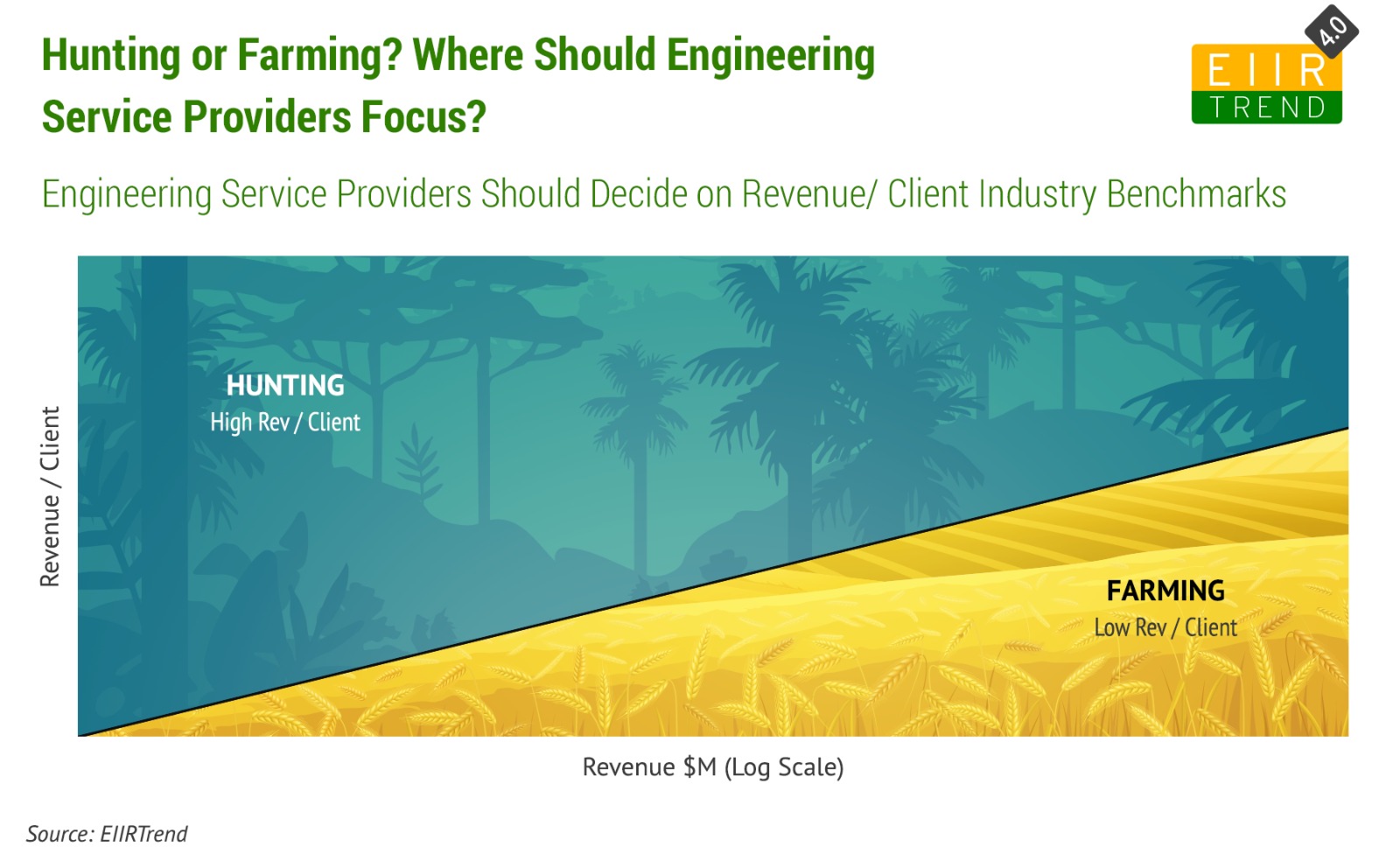
How to use the Revenue Per Client Growth curve?
- For a particular revenue, if an ESP’s revenue per client is close to the curve, it indicates a balanced position requiring focus on both hunting and farming.
- If ESP’s revenue per client is above the curve, then it has higher revenue per client ratio than the industry and it should focus more on hunting. It needs to look out for new clients more than growing existing clients.
- If ESP’s revenue per client is below the curve then it has lower revenue per client ratio than industry and it should focus more on farming. It needs to grow its existing clients more than acquiring new clients.
Observation: State of Engineering Services Industry Through Revenue Per Client Lens
We found a large variation in the number of clients and revenue per client ratio.
Even among engineering service providers with similar revenues, the number of clients can differ widely. For example, for nearly similar revenue, one engineering service provider had 100+ clients where as other service provider had 30 clients. The former should prioritize farming, while the latter should focus on hunting.
We see the difference in their M&A strategy also. The former's acquisitions are around horizontal services filling the skills and offering gaps in their existing verticals whereas latter's acquisitions are around getting client access in new industry verticals and geographies.
Sometimes low revenue per client gives illusion of farming opportunities across so many clients but many of these are low value clients without farming opportunities. In that case, some providers actively prune low-value clients to improve their revenue per client ratio before pursuing higher-value opportunities.
Why is This Important?
The choice between hunting or farming strategy will impact investments, hiring, organization structure, acquisitions and overall strategy.
If priority is farming, then providers should:
- Strengthen account management team, hire client-facing consulting people and vertical domain experts who can help in account mining, develop trust.
- Setup large deals office.
- Change organization structure that encourages P&L at customer level instead of service offerings level and encourage collaboration between different service lines.
- Incentivize customers with the value proposition of attractive volume discounts and investments in innovation programs, labs, and tools if engagement is of a certain scale.
- Acquire companies to fill skill and offering gaps.
If priority is hunting, then providers should:
- Strengthen sales team, hire hunters who can help in getting a foot in the door in new accounts.
- Change organization structure where sales is detached from the delivery and leaders are also evaluated on new business generated.
- Open sales offices and delivery centers in new locations.
- Invest in new services which may be a door opener, such as R&D Consulting, AI Advisory, which may not be highly profitable standalone, but helps generate downstream revenue.
- Acquire companies to get market and client access.
Bottom Line:
Growth is not about choosing hunting or farming in isolation. It is about aligning the entire organization around the chosen strategy.
Too often, engineering service providers attempt both without alignment and fail to see results. What works for one provider may not work for another or even for the same provider at a different stage.
The revenue per client lens provides a practical way to make that choice at the right time, in the right context.



 Pareekh Jain
Founder of Pareekh Consulting & EIIRTrends
Pareekh Jain
Founder of Pareekh Consulting & EIIRTrends
Add comment